
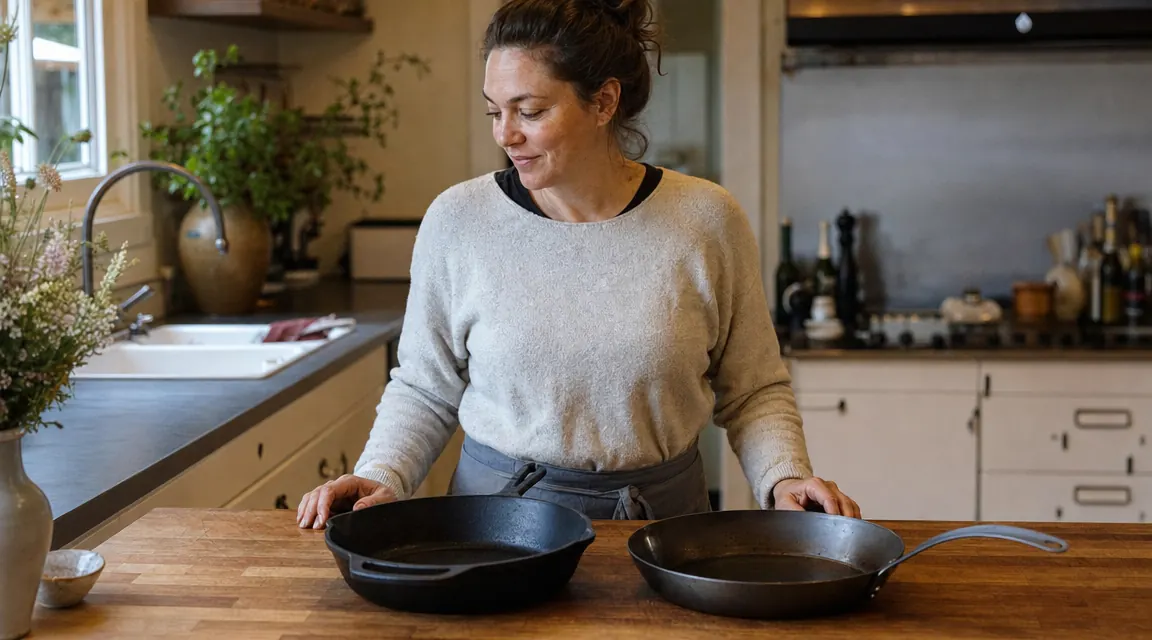
If you are standing in the cookware aisle, or scrolling Amazon at 10pm after the kids are in bed, trying to decide between a cast iron skillet and a carbon steel pan, you are not alone. I spent two weeks doing exactly that research before I bought my Lodge. Both pans skip the nonstick coating, both get more slippery as they season up over time, and both have serious fans who will tell you theirs is the only pan worth owning. The honest answer is that they are different tools that suit different cooks. Here is what actually matters when you have a family to feed on a Tuesday night.
The short answer: the Lodge 12-inch cast iron skillet wins for most home cooks. It is cheaper, more forgiving to season, holds heat better for searing, and it is practically indestructible. If you are also thinking about camping or cooking over an open fire, it is not even a close call. Carbon steel has real strengths, and I will cover them honestly, but for a practical, cost-conscious cook who wants one versatile pan that lasts a generation, cast iron is the pick.
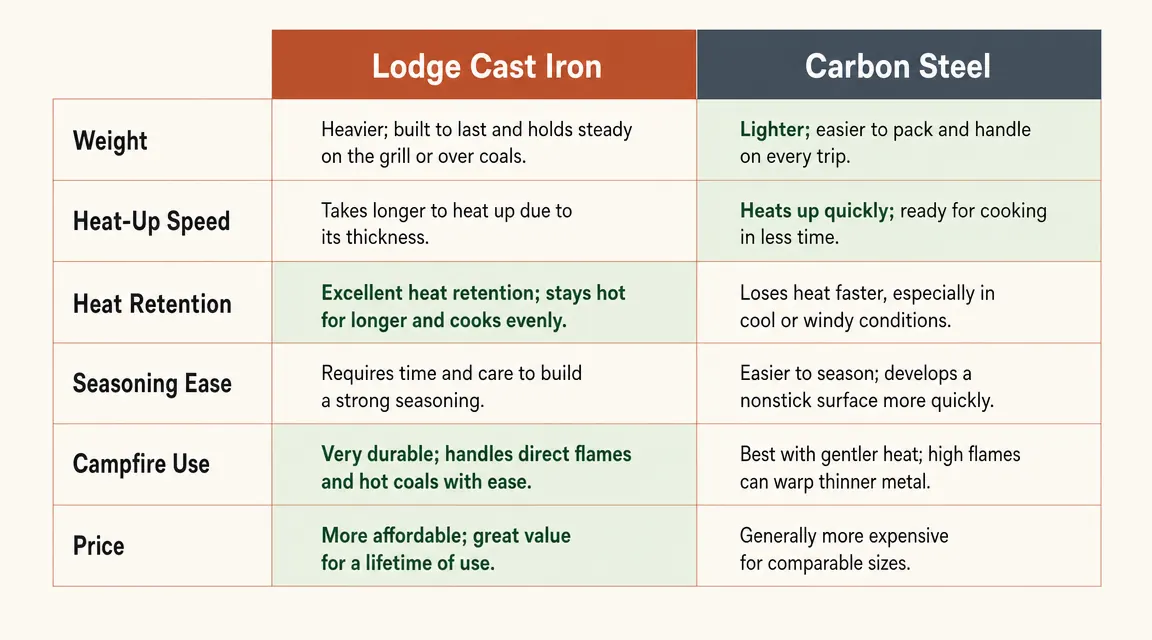
| Lodge Cast Iron (12 in.) | Carbon Steel Pan (10-12 in.) | |
|---|---|---|
| Price | ~$35 | ~$60-$150 |
| Weight (12-inch) | ~8 lbs | ~3-4 lbs |
| Heat-Up Speed | Slower (3-5 min) | Faster (1-2 min) |
| Heat Retention | Excellent | Moderate |
| Seasoning Difficulty | Forgiving, already pre-seasoned | More finicky, bare metal |
| Oven Safe | Up to 500F (broiler safe) | Up to 600F |
| Induction Compatible | Yes | Yes |
| Campfire / Open Flame | Excellent | Works, but thinner |
| Best For | Searing, baking, camping | Fast sautes, eggs, crepes |
Where the Lodge Cast Iron Wins
Heat retention is the Lodge's defining strength. Once that thick iron is hot, it stays hot. When you lay a cold chicken breast or a burger patty in the pan, a thinner pan drops temperature fast and you end up with steamed meat instead of a sear. Cast iron barely flinches. My Lodge holds its heat so well that I regularly pull it off the burner, carry it to the table in a towel, and whatever is inside keeps cooking for another few minutes. That thermal mass is the entire reason cast iron produces the kind of crust you cannot replicate on a thin stainless or nonstick.
Price is the other big win. The Lodge 12-inch consistently lands around $35 on Amazon. A comparable carbon steel pan from a reputable brand, like de Buyer Mineral B or Matfer Bourgeat, runs $60 to $130 depending on size. You are paying for the lighter weight and faster heat-up, but if your budget is finite and you need one great pan, that $35 Lodge does more jobs per dollar than anything else in its class. Plus it comes factory pre-seasoned with Lodge's proprietary vegetable oil seasoning, so you do not start from bare metal the way you do with most carbon steel pans.
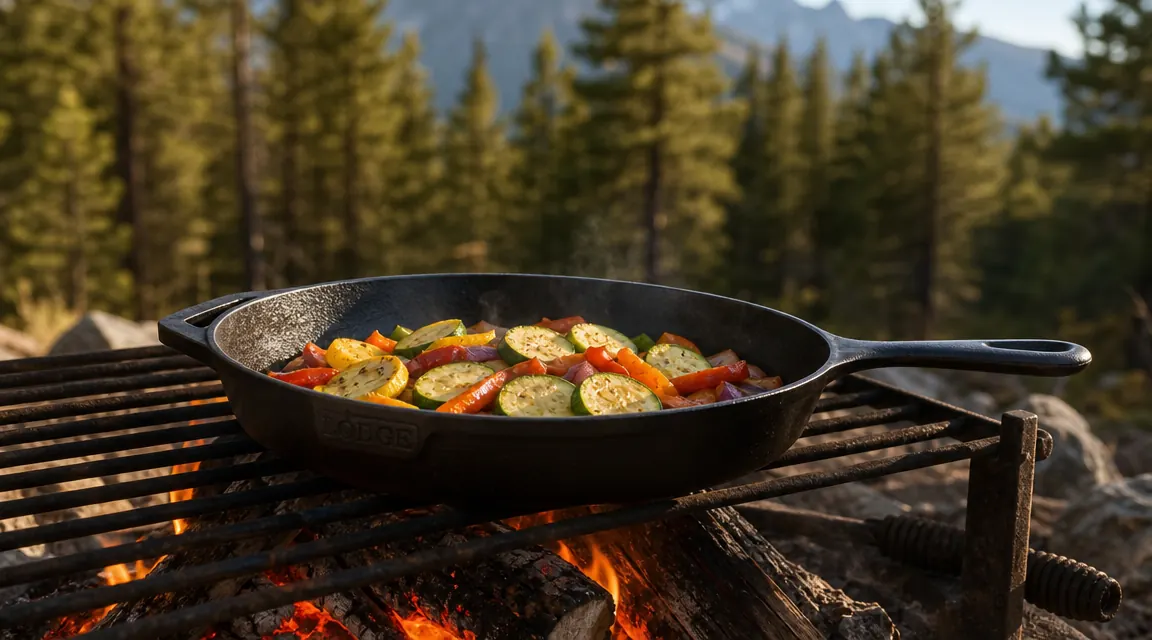
And then there is the campfire question. I take my Lodge on every camping trip. It goes on a grate over a wood fire, no modification required, and it comes home with a better season than when it left. A carbon steel pan can handle campfire heat technically, but its thinner walls heat unevenly over an unpredictable wood fire, and if the fire surges it can warp. Cast iron is essentially a brick. It does not care if the flames are uneven.
The last pan you buy at this price point, check the Lodge 12-inch today
Over 164,000 reviews, pre-seasoned from the factory, and safe for every heat source including open campfires. See today's price on Amazon.
Amazon Check Today's Price on Amazon →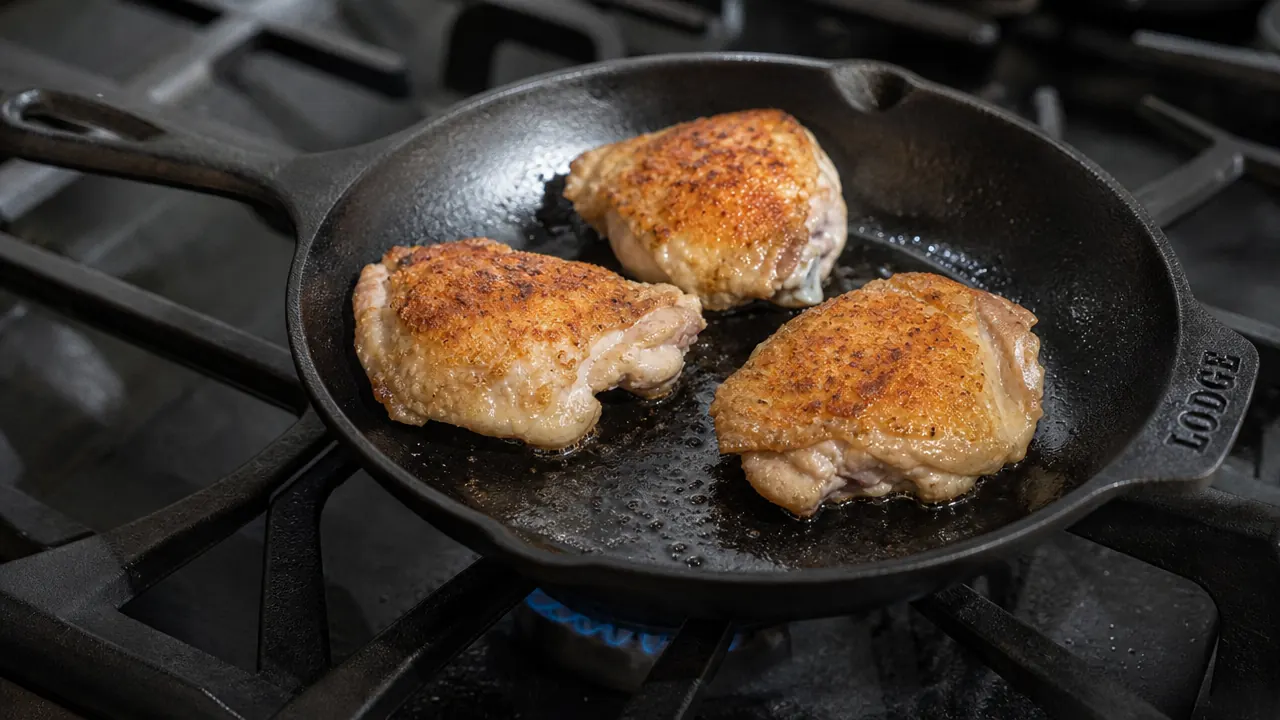
Where Carbon Steel Wins
Weight is the real argument for carbon steel. A 12-inch cast iron skillet weighs around 8 pounds. That is a lot to lift with one hand when you are draining water or flipping a big frittata. A carbon steel pan in the same size comes in around 3 to 4 pounds. If you have wrist issues, or if you cook standing at a high-sided pot without a towel, the weight difference is not trivial. Older cooks, shorter cooks, or anyone who finds their Lodge sitting on the back burner because it feels like a workout to move around should seriously consider carbon steel.
Carbon steel also heats up faster and responds to temperature changes more quickly. This matters for delicate cooking: eggs, crepes, thin fish fillets. When you need to drop the heat immediately and have the pan respond within seconds, a lighter pan with thinner walls reacts the way a good stainless pan does. Cast iron is the opposite. It takes patience to heat and patience to cool, which is a feature for searing but a drawback for anything that needs rapid temperature adjustment. Professional line cooks often prefer carbon steel because they need a pan that changes temperature with the dial, not one that keeps its own internal schedule.
Carbon steel heats faster and responds quicker. Cast iron holds heat longer and cooks more forgivingly. One is a sports car. The other is a pickup truck. Most families need the truck.
The Seasoning Reality Check
Both pans require seasoning, but they are not equally forgiving. Lodge ships pre-seasoned. That factory coat is good enough to cook on immediately and it builds naturally with use. You can strip the seasoning by leaving it wet or soaking it in soapy water, but under normal use the Lodge just gets better over time without much intervention. My Lodge has been in daily rotation for two years. I wipe it out with a paper towel after use, rub a small amount of oil in while it is still warm, and that is genuinely all the maintenance it gets.
Bare carbon steel pans come uncoated and require you to build a seasoning from scratch before they are reliably nonstick. The process is not hard, but it requires more attention and more initial failures before the pan behaves well. Some carbon steel pans, like the de Buyer Mineral B, have a beeswax coating on them from the factory, which helps, but you still need to work through a few burn-in rounds before the cooking surface is smooth and releasing cleanly. If you are a person who wants to pull the pan out of the box and cook dinner tonight, cast iron wins that round clearly.
Oven and Broiler Performance
Both pans handle oven use well, but carbon steel has a slight edge on max temperature. Most carbon steel pans are rated to 600F and some can handle brief broiler exposure without issue. Lodge cast iron is rated to 500F for most use cases, though Lodge's own documentation says it can handle higher heat for short periods. In practice, for a home cook baking cornbread, finishing a seared steak in the oven, or making a giant sheet-pan frittata, neither pan will limit you. The oven-temp distinction only matters if you are doing specific high-heat baking techniques where exact temperature control is critical.
One practical note: both pans get extremely hot handles in the oven. Lodge handles are bare iron with no insulation. Carbon steel handles are the same. Budget for a silicone handle cover or a thick kitchen towel, whichever pan you pick, you will use it constantly and forgetting this detail burns fingers. I keep a set of silicone handle covers hanging on the side of my Lodge at all times.
Cooking on Induction
Both cast iron and carbon steel work on induction burners because they are both magnetic. If you are upgrading to an induction cooktop or already have one, either pan works without an adapter. This is not a differentiator between the two, but it is worth confirming if you are coming from a household where someone told you cast iron does not work on induction. It does. My Lodge heats on an induction burner without any issues, and if anything the induction burner's flat surface and even heat distribution pairs well with the flat cooking surface of a well-seasoned cast iron.
Who Should Buy Which
Buy the Lodge cast iron if you want one versatile pan that handles the widest range of cooking at the lowest price. It excels at searing, baking, frying, oven finishing, and campfire cooking. It tolerates beginner mistakes with seasoning, it is already ready to cook when it arrives, and at $35 it is less expensive than almost any other quality pan in its category. If your kitchen has room for one new pan, this is the one.
Consider carbon steel if you cook a lot of fast sautes and eggs, you find heavy pans genuinely difficult to manage, or you want a pan with the cooking properties of cast iron but at roughly half the weight. Carbon steel suits confident cooks who are comfortable building seasoning and who cook delicate items more often than steaks. It rewards technique. The Lodge rewards consistency.
If you are still on the fence, consider this: many serious home cooks own both. But if you are buying your first quality uncoated pan, the Lodge 12-inch is where I would put my money. You can always add a carbon steel pan later once you understand how uncoated cookware works. It is much harder to work backward from a carbon steel pan you find frustrating and decide you want cast iron. The Lodge entry point is low enough that starting there makes practical sense.
I have linked to my detailed Lodge review and to the cast iron care guide below if you want to dig deeper before you order. Both articles will give you a clearer picture of what life with this pan actually looks like week to week.
Internal links: Lodge Cast Iron Skillet Review: Two Years of Weeknight Dinners | Cast Iron Care Made Simple: How to Season, Clean, and Store Your Lodge Skillet
Ready to stop debating and start cooking? The Lodge 12-inch is the practical pick.
Pre-seasoned, campfire-ready, oven-safe to 500F, and backed by 164,000+ reviews. See the current price on Amazon before you decide.
Amazon Check Today's Price on Amazon →