
I have a confession that probably every home cook can relate to: I owned a full knife block for eight years and used exactly one knife in it. The others looked impressive on the counter, but they barely left the block. It was the chef knife or nothing. When my old one finally gave up, I spent two weeks reading reviews and nearly bought something in the $150 range before my coworker Janelle stopped me. She has run a catering side business for a decade and she said four words: 'Get the Victorinox Fibrox.' I almost didn't believe her, but I ordered it, and that was two years ago. The Victorinox Fibrox Pro 8-inch chef knife has been on my cutting board almost every single evening since, handling everything from weeknight veggie stir-fries to breaking down a whole chicken for soup.
This review is the long-term picture. Not the out-of-the-box first impression, which is honestly not that exciting because the knife looks kind of plain. I want to tell you what using it five nights a week for two years actually feels like, what surprised me, what I wish were different, and whether I would hand it to my daughter when she sets up her first apartment.
The Quick Verdict
The Victorinox Fibrox Pro is the smartest knife purchase a home cook can make. It is sharp, stays sharp longer than its price would suggest, and the handle is comfortable enough to use for a full Sunday meal prep session without hand fatigue. It is not beautiful and it is not for people who care about impressing guests with a fancy knife block. It is for people who just want to cook dinner.
Amazon Check Today's Price →Still slowing down on every carrot and onion? This is the knife that fixes that.
The Victorinox Fibrox Pro 8-inch is a 4.7-star knife with nearly 10,000 reviews and a current price that makes most other options look like a bad deal. Check today's price before it changes.
Amazon Check Today's Price on Amazon →How I've Used It
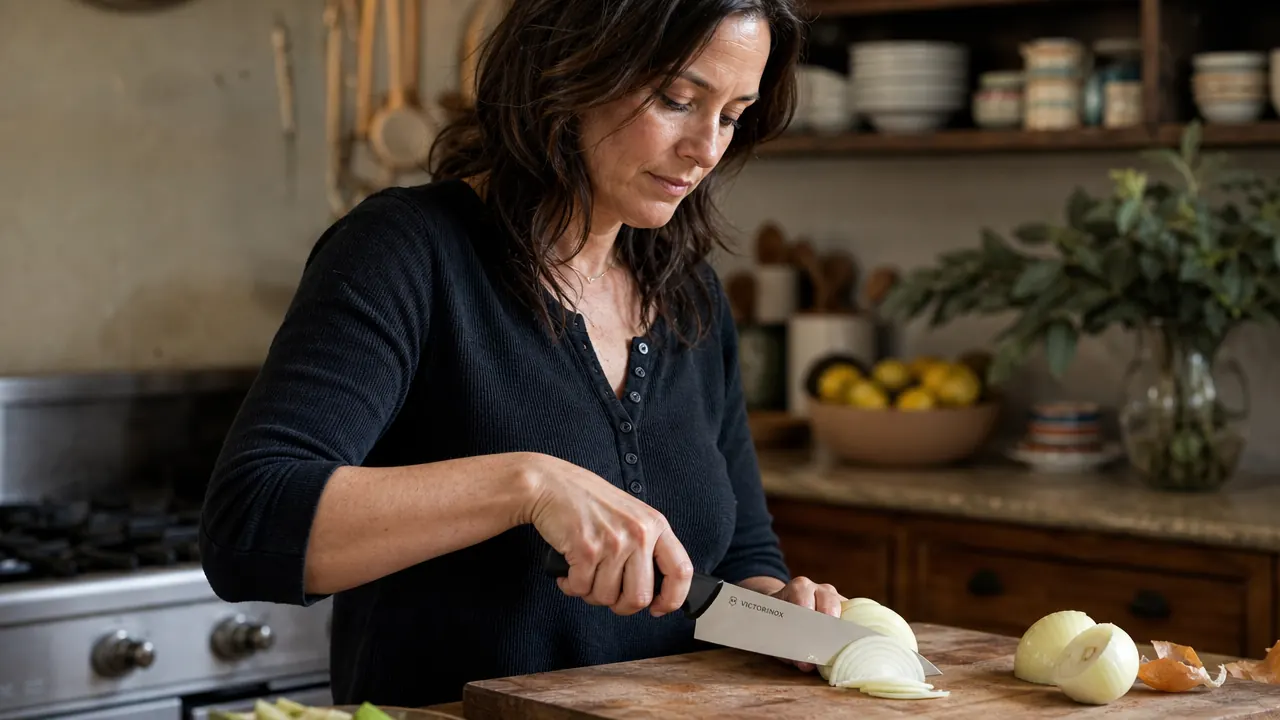
I am not a chef. I am an accounting assistant and mom of two kids who are now 11 and 14, which means I have been packing school lunches and cooking weeknight dinners on a schedule that does not leave room for fussing over equipment. My kitchen is a real family kitchen: scratched counters, a plastic cutting board that needs replacing, and about 40 minutes from walking in the door to food on the table. That is the environment this knife lives in.
Over two years, the Victorinox Fibrox Pro has prepped probably 600 weeknight dinners. Conservatively. Onions nearly every night. Carrots, celery, peppers, chicken breasts, pork tenderloin, the occasional butternut squash that made me regret not buying pre-cut. I have also packed it for two camping trips in a hard case because I cannot go back to using whatever dull folding knife we kept in the camp box. It travels well and the handle does not feel slippery even when my hands are wet, which matters a lot at a campsite with a communal water jug ten feet away.
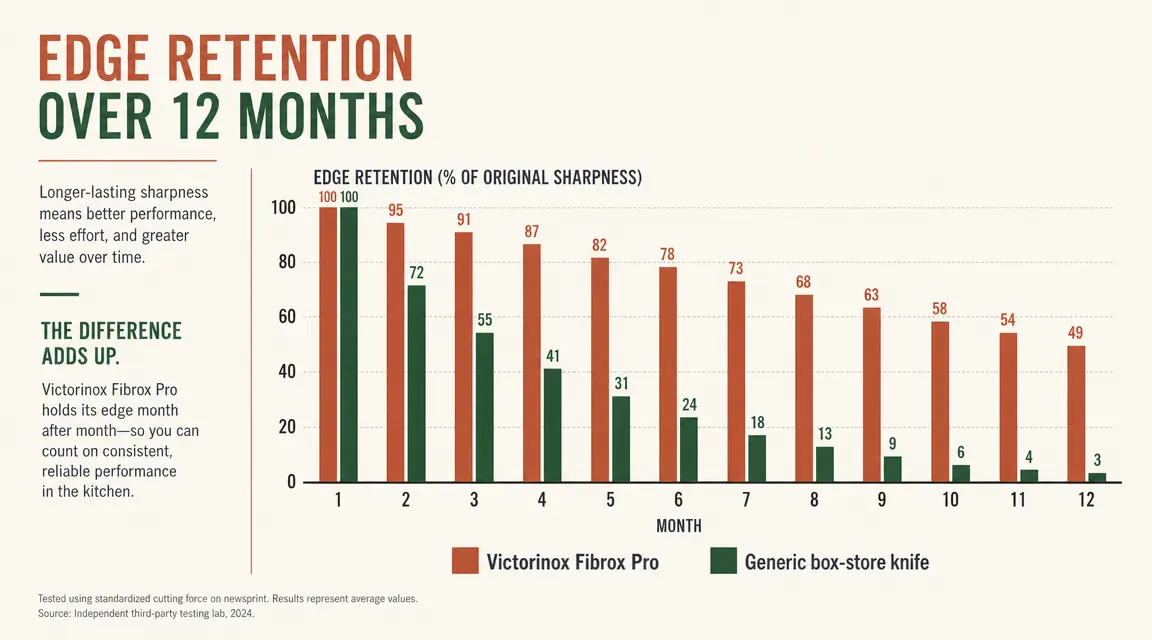
I hone it on a simple ceramic rod about once a week and have had it sharpened on a whetstone once, at about the 18-month mark. For context, my old knife needed sharpening every three months just to stay usable. The Fibrox held its edge in a way that genuinely surprised me.
The Blade: High Carbon Stainless Steel at Work
The Victorinox Fibrox Pro is made with high carbon stainless steel that Victorinox makes in Switzerland. The blade is 8 inches, which is the sweet spot for most home cooks. Long enough to use a rocking motion on herbs or break down a chicken, short enough to maneuver around small vegetables without feeling unwieldy. The edge comes from the factory at around 15 to 17 degrees per side, which is sharper than most German knives and noticeably more acute than budget blades.
In practical terms, fresh out of the box it sliced a ripe tomato without any downward pressure, which is the test I use on every knife before I trust it for real work. Cheap knives crush the skin before cutting. The Fibrox went through cleanly. After two years, it still passes that test after a quick touch-up on the honing rod. The steel is not as hard as Japanese knives, which means it is slightly more forgiving if you hit a bone or a very hard vegetable without consequence. But it does require more frequent honing than a 60+ Rockwell hardness blade would.
Fresh out of the box it sliced a ripe tomato without any downward pressure. After two years of weeknight use, it still passes that test after a quick touch-up on the honing rod.
The Handle: The Part Nobody Talks About Enough
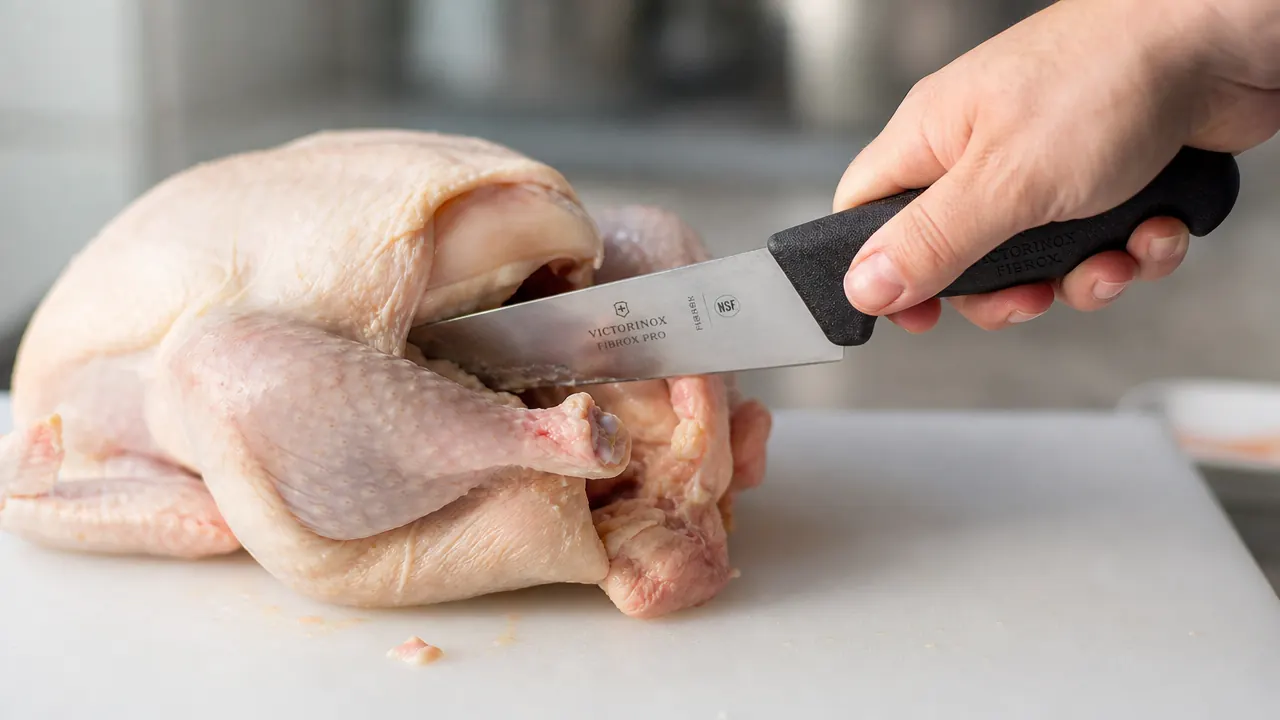
I want to spend a minute on the handle because it is genuinely one of the best things about this knife and also the thing that makes it look kind of cheap in photos. The Fibrox handle is a textured thermoplastic rubber material that feels grippy even when wet. It is not pretty. It does not have the warmth of walnut or the prestige of riveted steel bolsters. It looks like something a culinary student would use, which is exactly the point because culinary students do use it. A lot of culinary schools issue this knife specifically because it can be washed in a commercial dishwasher repeatedly without the handle cracking or delaminating.
For home cooks, what that translates to is a handle that stays comfortable during a 45-minute Sunday meal prep session where you are moving fast and your hands get wet from rinsing vegetables. I have held expensive knives with gorgeous rosewood handles that gave me a hot spot on my palm after 20 minutes of real work. The Fibrox handle has never done that. It is also NSF certified food-safe and the texture means the knife does not shift in your grip when you transition from a dry cutting board to a wet chicken breast.
Performance Over Time: What Held Up and What Changed
Here is the honest two-year picture. For the first six months, I barely noticed the knife wearing in at all. Edge retention was noticeably better than what I had been using. Around months seven through twelve, I started honing it more consistently, maybe twice a week instead of once, to keep it at peak performance. The knife did not get dull, it just needed a bit more maintenance attention as the factory edge gradually softened with use.
At 18 months I took it to a local kitchen store and paid eight dollars to have it sharpened on a whetstone. It came back feeling nearly identical to new. That is an important point about value: this knife rewards proper care and responds well to sharpening. Some budget blades have steel that does not sharpen cleanly and develops micro-chips along the edge over time. The Fibrox has sharpened evenly every time I have touched it up. Post-sharpening it felt genuinely excellent, and that carried through to the end of year two where it still sits today.
One thing I noticed: the heel of the blade has a slight curve upward where it meets the handle, which limits your knuckle clearance on a thin cutting board. If you use a board thinner than about three quarters of an inch you will scrape your knuckles on a pinch grip. I switched to a thicker board and the problem went away, but it is worth knowing before you buy.
How It Compares to What I Almost Bought
Before I landed on the Fibrox, I was seriously looking at knives in the $80 to $150 range from German brands with household names. I am glad I did not buy them. Not because they are bad knives but because for my cooking style and my actual skill level at sharpening and maintaining a blade, the Victorinox gives me 90 percent of the performance at a fraction of the cost. The expensive knives often have harder steel that holds an edge slightly longer but requires more skill to sharpen at home without chipping. The Fibrox is more forgiving and the financial stakes are lower if you mess up a sharpening.
I have also used a Japanese gyuto in the $100 range that a friend brought over once. It was sharper out of the box, no question, and the blade geometry felt refined. But it was also thinner and required more care around bones and hard produce. For breaking down a chicken or halving a butternut squash on a weeknight without thinking twice, the Fibrox is actually more practical. You can see a full comparison of the Fibrox against the Wusthof Gourmet in our head-to-head comparison, but the short version is that the price gap does not translate to a proportional performance gap for most home cooks.
What I Liked
- Holds a working edge for months between proper sharpenings with regular honing
- Textured handle is genuinely comfortable during long prep sessions and does not slip when wet
- Swiss high carbon stainless steel sharpens cleanly and responds well to a whetstone
- Dishwasher-safe handle design means it survives real family kitchen use
- The current price makes the value calculation almost embarrassingly easy
- Lightweight enough (less than 7 ounces) that it does not fatigue your wrist during a big cook
Where It Falls Short
- The heel-to-handle junction limits knuckle clearance on thin cutting boards
- The Fibrox handle looks utilitarian and will not impress guests eyeing your knife block
- Not as razor-sharp out of the box as purpose-built Japanese blades in the same price range
- Requires regular honing to maintain peak performance, not a totally low-maintenance knife
Who This Is For
This knife is for the home cook who wants one reliable blade that handles everything, does not need to look good in a knife block, and is not going to stress about maintaining a $200 investment. If you are cooking four or five nights a week, packing lunches in the morning, and occasionally bringing a knife along for a camping trip or potluck, this is the knife. It is also a great first-real-knife for someone setting up an apartment who has been using whatever came in a block from a big box store. The jump in performance is immediate and noticeable. If you want to go deeper on all the reasons this blade earns its space, check out our full 10 reasons the Victorinox Fibrox Pro is the best value chef knife piece.
Who Should Skip It
If you are a serious home cook who has put time into learning Japanese blade geometry and sharpening techniques, you will probably find the Fibrox a little soft and its profile less precise than what you are used to. It is not a knife for people who enjoy the ritual of blade maintenance as much as the cooking. And if aesthetics matter to you, if you want something that looks beautiful on the counter or makes a great gift impression, this is not that knife. The handle looks like a kitchen tool. Which it is. But presentation-wise, it will not wow anyone.
It is also worth noting that at 8 inches, this is a full-size chef knife. If you have smaller hands or you are working in a galley kitchen with a small cutting board, the 6-inch Fibrox Pro might be worth considering instead. The 8-inch is the most versatile size but it is a real 8 inches.
Two years in, I would buy this knife again without hesitating.
The Victorinox Fibrox Pro 8-inch chef knife is rated 4.7 stars by nearly 10,000 buyers. It is the knife Janelle told me to get and the knife I would tell you to get. Check today's price and see if it fits your budget.
Amazon Check Today's Price on Amazon →